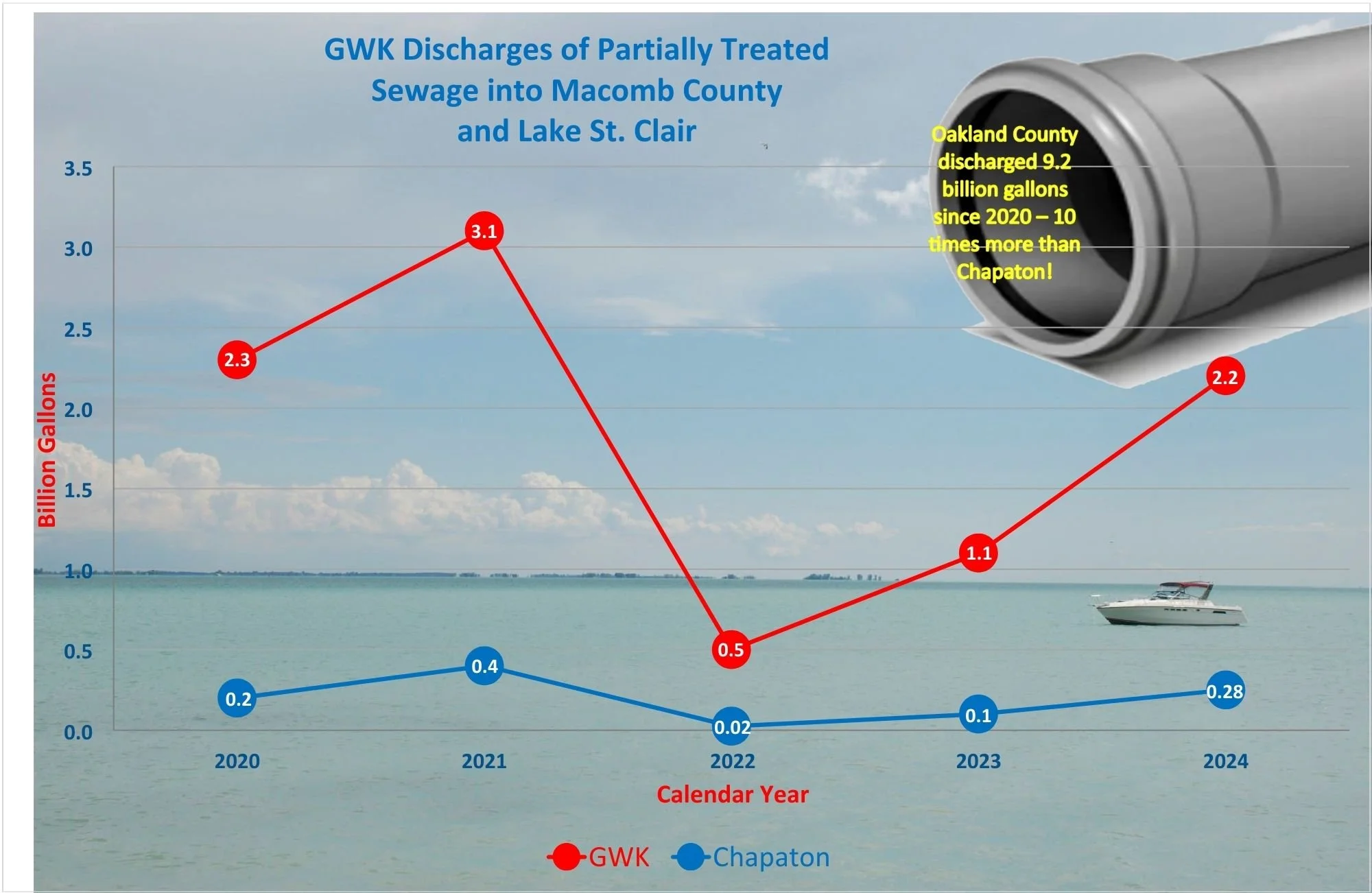

September, 2024 - Oakland County officials pushed back against claims the county is polluting Lake St. Clair by discharging fully and partially treated raw sewage into the lake from its treatment facility Those are claims made by officials and residents in Macomb County.
July, 2025 - Michigan environmental regulators threatened Oakland County with fines and penalties over repeated raw sewage discharges into the Red Run Drain, escalating a long-running dispute between Oakland and Macomb counties over water management. The Michigan Department of Environment, Great Lakes and Energy (EGLE) issued an enforcement notice citing Oakland County for violating state environmental laws.
April, 2025 - Some waterfront residents are on the frontlines of a losing battle with an algae clogging their lakes, their canals and limiting their access to the water. One lawmaker’s bill would streamline the cleanup process.
DENIAL
Last significant improvement to reduce CSOs was at the George W. Kuhn done in 2006 by increasing storage capacity to 124 million gallons and adding enhanced screening and disinfection processes.
ENFORCEMENT NOTICE
EGLE finally issued a June 27 enforcement notice to the Oakland County Water Resources Commissioner’s Office citing violations of the state’s Natural Resources and Environmental Protection Act, including a massive discharge of 1.18 million gallons of untreated sewage in April and more than 2 million gallons in August of last year. The state now plans to impose an Administrative Consent Order requiring corrective action, financial penalties, and potentially further legal consequences if violations continue.
TAKING ACTION IN LANSING
Brown Alert Plan (House Bill 4427)
State Rep. Alicia St. Germaine (R-Harrison Township) led the Michigan House with strong bipartisan support in approving her plan to quickly notify residents when raw sewage or dangerous bacteria contaminate local waterways.
House Bill 4427, also known as the “Brown Alert” plan, would ensure the public is warned when public drains, river systems, and lakes become unsafe due to E. coli or sewage contamination. Under this bill, when a county health department determines that a body of water has reached dangerous contamination levels where it is unhealth to touch, they must notify the county’s emergency manager. The emergency manager would then issue a “Brown Alert” through the Wireless Emergency Alert system, notifying residents of unsafe conditions.
The alerts could warn communities of unsafe waterways, swimming areas, risks to drinking water, or potential harm to local fish and wildlife.
Purpose of Combined Sewer Systems (CSS)
Integrated Management: CSS were originally designed to collect and transport both sanitary wastewater and industrial wastewater along with rainwater (stormwater) runoff in a single pipe system.
Overflow Protection: To prevent sewage from backing up into buildings or overflowing during extreme wet weather, these systems include "overflow valves" or outlets.
Environmental Impact: When the capacity of the pipes or treatment plant is exceeded, the system discharges a diluted mix of stormwater and untreated wastewater—known as a Combined Sewer Overflow (CSO)—directly into nearby water bodies.
Improvement Notes
Last improvement to reduce CSOs was at the George W. Kuhn in 2006, TWENTY YEARS AGO. At that time, the storage capacity was increased to 124 million gallons, and enhanced screening and disinfection processes were implemented.
Bottom Line: Much of the CSS infrastructure is again requiring significant repairs and modernization. The high cost of upgrading and maintaining the CSS poses a major challenge with limited funding available for large-scale infrastructure projects.
Data Table Note
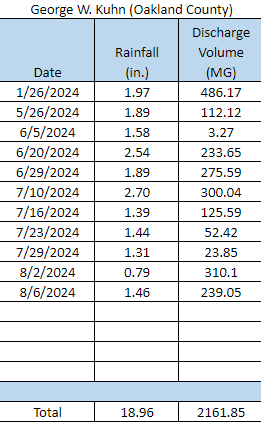
The far right column shows the amount of discharged water from Oakland County. This amount flows downhill right into Macomb County and out into Lake St. Clair.